Home / Comparisons / Continuous band sealer vs Vacuum sealer
Continuous band sealer vs Vacuum sealer
Both are on our sealing line, and the most common mistake we see is choosing on pack width alone. This page sets out what actually decides it.
A band sealer closes a pouch; a vacuum sealer removes air to extend shelf life. If shelf life, moisture or oxidation is not the driver, band sealing is usually enough.
These machines solve different problems, so the choice follows the product. A continuous band sealer heat-seals a pouch at a steady rate and suits dry goods where shelf life is not the constraint. A vacuum sealer removes air to slow oxidation and spoilage, and is needed where moisture, shelf life or pack rigidity matter.
Continuous band sealer · Vacuum sealer
| Dimension | Continuous band sealer | Vacuum sealer |
|---|---|---|
| What it does | Heat-seals the open edge of a pouch or bag | Removes air from the pack before sealing |
| Shelf life effect | Closes the pack; does not slow oxidation | Extends shelf life by removing oxygen |
| Product moisture | Best with dry goods | Handles wet and powdery products where the machine is a chamber type |
| Pack appearance | Soft, conforming pack | Firm, compact pack |
| Throughput | Continuous; suited to steady line speed | Batch or cycle-based, depending on the type |
| Consumable sensitivity | Film material and thickness must match the sealer | Film and chamber size must match the product |
| Common misbuy | Bought on pack width, then film will not seal at speed | External type bought for a wet product, where liquid reaches the pump |
| Best fit | Dry goods, retail pouches, high steady output | Meat, seafood, liquids, sous-vide, extended shelf life |
Choose this when Continuous band sealer
- The product is dry
- Shelf life is not the deciding factor
- You need steady continuous output
- The pack is a pre-made pouch or bag
Choose this when Vacuum sealer
- The product is wet, moist or oxygen-sensitive
- Shelf life is the whole point
- You need a firm, compact pack
- The pack must survive freezing or transport pressure
Confirm before you order
Once these are settled, the choice usually stops being contentious.
- Bag or film material, thickness and whether it is laminated
- Product moisture, particle size and temperature
- Target output in packs per minute
- Whether gas flushing is required
- Chamber or pack dimensions against the product
Related configurations

Common questions
Can a vacuum sealer replace a band sealer?
Not on a continuous line. Vacuum machines work in cycles, so they suit batch or semi-automatic production rather than a steady inline flow. If your line runs continuously, band sealing is the mechanism that fits.
Do I need a chamber or an external vacuum sealer?
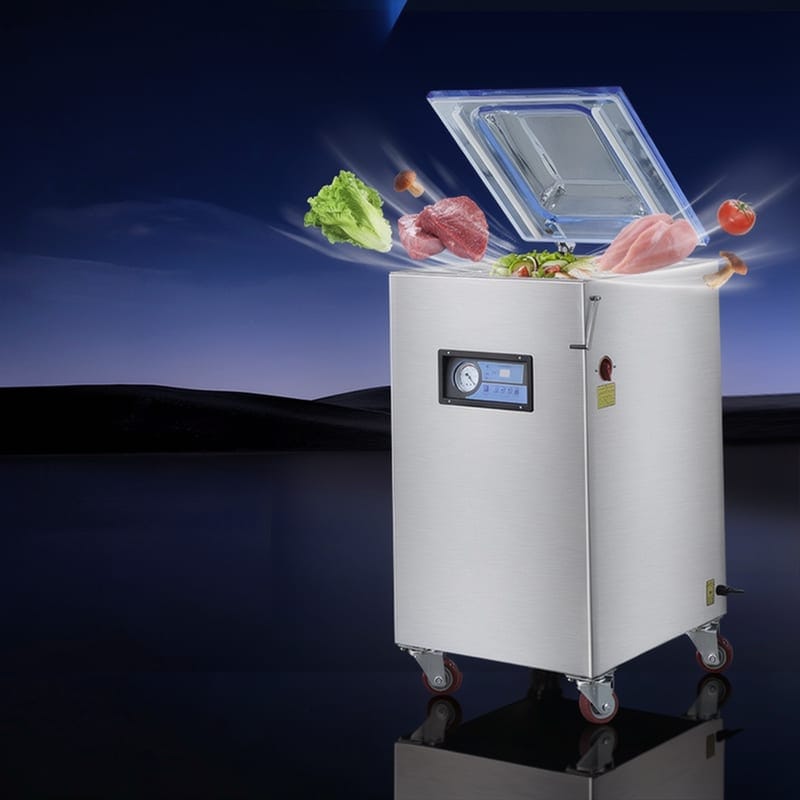
Chamber machines put the whole pack inside a vacuum chamber, which is what you need for wet or powdery products. External suction machines are simpler but draw air — and liquid — through the nozzle, so they suit dry goods.
Will a band sealer work with laminated film?
It depends on the film. Laminated and thicker films need different temperature, pressure and dwell settings, and some will not seal reliably on a given machine. Send the film specification and we will confirm rather than assume.
What about nitrogen flushing?
Gas flushing is a separate requirement that changes the machine configuration. If you need it, say so at the start — it is not something that can be assumed to be included.
Other comparisons
Not sure which case you are?
Describe the actual conditions — load, site, destination — and we will place it and tell you which questions matter.