Home / Electric Forklifts / 1–1.5 ton
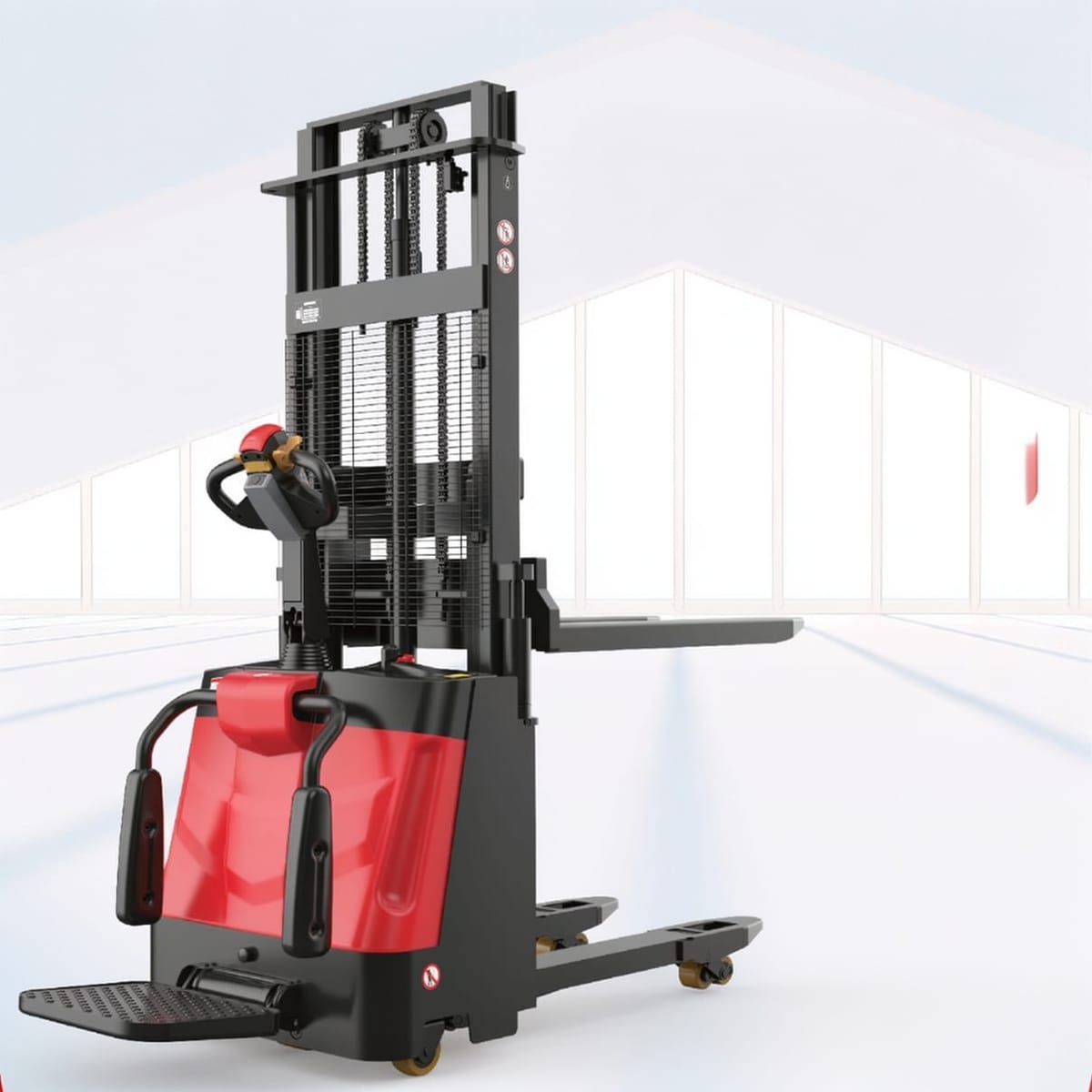
1–1.5 Ton Electric Forklift
Light palletised goods, narrow aisles, small warehouses and shops where a bigger truck would be wasted and would not fit.
A 1–1.5 ton electric forklift suits light palletised goods in tight spaces. At this capacity the constraints are almost always aisle width, door openings and lift height rather than load weight. It is the size where a compact footprint buys you usable storage that a larger truck would make unreachable.
What is different at this capacity
| Footprint | Compact; usually the deciding factor in small premises |
| Aisle requirement | Narrower than a 2-ton class truck |
| Battery | Smaller pack; often 24 V or a low 48 V class |
| Typical duty | Single shift, light loads, short transfer distances |
| Mast | Usually two-stage or three-stage with limited free lift |
Choose this capacity when
- Loads are under about 1.2 tonnes on a standard 500 mm load centre
- The aisle or doorway is the binding constraint
- Floor loading limits how heavy a battery pack is practical
- Work is indoor, single shift, over short distances
Common misjudgements
Buying a 2-ton class truck for 1-ton loads, then finding it cannot turn in the aisle
Assuming rated capacity applies at full lift height, when it falls as the load rises
Ignoring the battery pack weight against floor loading limits in older buildings
1–1.5 Ton Electric Forklift
| Rated capacity | 1,000–1,500 kg |
| Load centre | 500 mm (confirm per route) |
| Lift height | 3,000–4,500 mm, mast dependent |
| Fork length | 1,070–1,150 mm |
| Power | Electric, 48 V class |
| Battery | Lead-acid or lithium; capacity confirmed per route |
| Charger | Included per supplier route, input voltage to your market |
| Tyre | Solid |
| Typical use | Standard pallets, indoor warehousing, food and packaging plants |
Values are reference ranges. The final specification is confirmed per supplier route against your actual application, and is not a commitment.
Common questions
Is a 1.5 ton forklift enough for standard pallets?
Usually, if the load is under about 1.2 tonnes at a 500 mm load centre and you are not lifting to full height with that load. Standard palletised goods in a small warehouse typically fit this class. What decides it is the actual load weight, the pallet dimensions and the maximum lift height.
What is the difference between 1 ton and 1.5 ton in practice?
Less than the numbers suggest. The physical size is often similar, so the practical difference shows up in the load chart at height rather than in the footprint. If your loads sit between the two, the load chart at your maximum lift height is what should decide it.
Can a 1.5 ton electric forklift work in a small shop?
It can, if the doorway and turning space allow it. In retail and small warehouse settings the constraint is usually the door width and the available turning circle rather than the load. Give us those two measurements and we can tell you whether this class fits.
Other capacities
Not sure which capacity you need?
Send the load weight, load centre, lift height and aisle width, and we will place it in the right class.