Home / Electric Forklifts / 3 ton
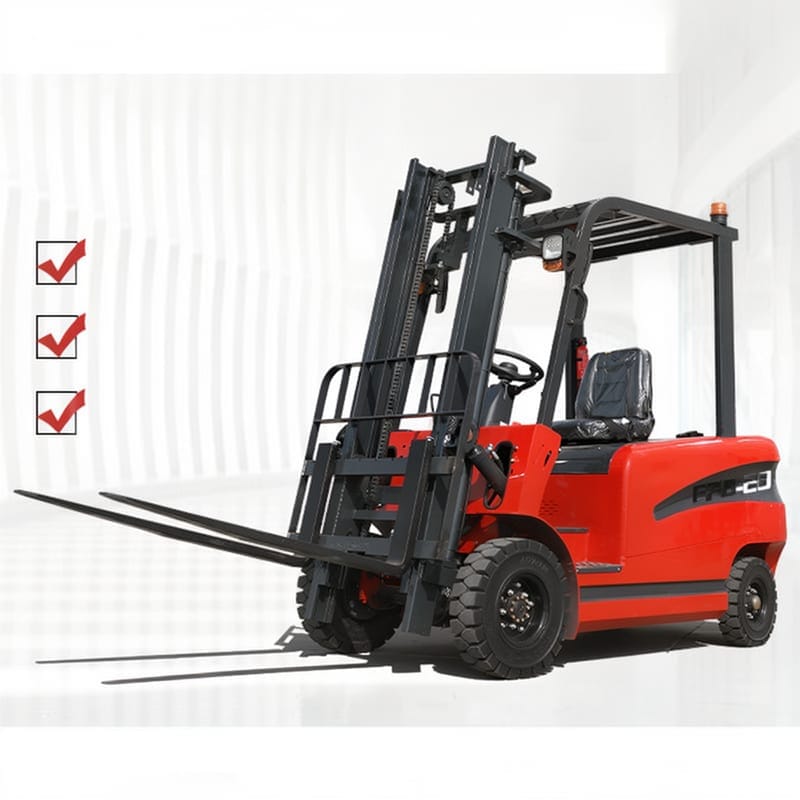
3 Ton Electric Forklift
Heavier palletised loads and double-stacked work, still indoors, where a 2-ton truck runs out of capacity at height.
A 3 ton electric forklift is for heavier loads and higher stacking, and it is usually chosen when a 2-ton truck runs out of capacity at the height you actually work. The capacity difference matters most at lift height, where the load chart falls away. Confirm the load chart at your working height rather than at ground level.
What is different at this capacity
| Footprint | Larger and heavier; aisle and floor loading both matter more |
| Battery | Larger pack; charging infrastructure requirements rise |
| Typical duty | Two shifts, heavier loads, higher stacking |
| Mast | Often three-stage; capacity check at height is essential |
| Floor loading | Point loading on the wheels has to be checked for older buildings |
Choose this capacity when
- Loads are heavier than a 2-ton class truck can lift to your working height
- Stacking is high and the load chart at height is the real constraint
- Floor loading supports the machine and its battery pack
- The aisle is wide enough for the larger turning circle
Common misjudgements
Comparing 2-ton and 3-ton on rated capacity alone, when the difference only appears at height
Adding a larger truck without rechecking floor point loading
Assuming the charging infrastructure that worked for a smaller pack still suffices
3 Ton Electric Forklift
| Rated capacity | 3,000 kg |
| Load centre | 500 mm (confirm per route) |
| Lift height | 3,000–6,000 mm, mast dependent |
| Fork length | 1,220 mm standard |
| Power | Electric, 48 V / 60 V / 80 V class depending on route |
| Battery | Lead-acid or lithium; capacity confirmed per route |
| Charger | Included or optional — confirmed per route |
| Tyre | Solid or pneumatic |
| Typical use | Dense pallets, container loading, heavy industrial handling |
Values are reference ranges. The final specification is confirmed per supplier route against your actual application, and is not a commitment.
Common questions
Do I need a 3 ton forklift or a 2 ton?
It depends on your load weight at your actual lift height. Rated capacity falls as the load rises, so a 2-ton truck that lifts its rated load at ground level may not do so at five metres. Give us the load, the lift height and the load centre and we can tell you which class actually holds.
Does a 3 ton truck need a bigger charging setup?
Usually yes, because the battery pack is larger and the charger output has to match it. Whether that means a higher-capacity charger, a three-phase supply or a longer charging window depends on your shift pattern. It should be planned at specification stage, not after the machine arrives.
What about floor loading in an older building?
It has to be checked. A heavier truck concentrates more load through its wheels, and older floors may not have been designed for it. That is a building question rather than an equipment question, but it should be settled before you commit to a larger class.
Other capacities
Not sure which capacity you need?
Send the load weight, load centre, lift height and aisle width, and we will place it in the right class.